Understanding Voltage Drop on Boats


Your bilge pump runs fine on the bench. You wire it into the boat, flip the switch, and it groans like it is half asleep. Nothing is broken, nothing is loose, and the fuse is intact. What you are almost certainly fighting is voltage drop, the quiet tax that every foot of wire charges against the electricity moving through it.
On a 12V boat, that tax matters far more than most owners expect. A house circuit runs at 120 volts, so losing a volt or two barely registers. Lose that same volt or two on a 12-volt circuit and you have shed a big chunk of the power your gear was counting on.
Understanding voltage drop in boat wiring is the difference between a system that works for years and one that leaves you chasing gremlins every season.
What voltage drop actually is
Every conductor fights the electricity moving through it a little. That resistance turns some of your voltage into heat instead of useful work, and the voltage that arrives at your device is lower than what left the battery. That difference is voltage drop.
Think of it like water pressure in a long garden hose. The pump at the tap pushes hard, but by the time water reaches the far nozzle, pressure has bled off along the way. A skinny hose bleeds more pressure than a fat one, and a longer hose bleeds more than a short one.
Wire behaves the same way. Thin wire and long runs both eat voltage, and current makes the loss worse in a hurry.
Why 12 volts is unforgiving
Voltage drop is usually measured as a percentage of the source voltage. On a 12V system, a 3 percent drop is only about 0.36 volts, which sounds trivial until you remember how little headroom you have to begin with.
Many marine electronics start misbehaving below 11 volts. Drop half a volt in the wiring, then a chartplotter draws hard and pulls the battery down under load, and suddenly your gear is browning out for reasons that have nothing to do with a bad battery.

The rule that keeps you honest: 3 percent and 10 percent
The American Boat and Yacht Council, the group that writes the safety standards most builders and surveyors follow, sets two targets for allowable voltage drop. Learn these two numbers and you have most of what you need.
- 3 percent for critical circuits: bilge pumps, navigation lights, electronics, VHF radios, anything where dim or weak performance is a safety problem.
- 10 percent for non-critical circuits: cabin lights, accessory outlets, a cockpit stereo, things that still work acceptably a little dimmer.
You can read the ABYC’s overview of DC systems on their official site, though the full standards are a paid document. For most owners, the two percentages above are the practical takeaway.
The three things that drive voltage drop
Only three variables matter, and once you can feel how they interact, sizing wire stops being guesswork.
1. Length of the run (round trip)
This is the mistake I see most weekends. People measure the distance from the battery to the device and stop there. But current has to flow out on the positive wire and back on the negative, so the length that counts is the round trip.
A depth sounder mounted 18 feet from your battery bank sits on a 36-foot circuit. Size your wire for 18 feet and you will be off by half, and your gear will pay for it.
2. Current (amps)
The more current a device pulls, the more voltage the wire eats. A 1-amp LED nav light and a 20-amp windlass motor on identical wire are living in different worlds. High-draw gear (anchor windlasses, thrusters, inverters, big pumps) is where voltage drop bites hardest.
3. Wire gauge (thickness)
Gauge is the one variable you actually control after the boat is built. Thicker wire has less resistance and drops less voltage. Just remember the counterintuitive part: a smaller gauge number means thicker wire. 6-gauge is much fatter than 14-gauge.
If you want the full walkthrough on picking conductor sizes for a given load and distance, our guide on how to choose marine wire gauge lays out the charts step by step.
A quick reference you can actually use
Here is a simplified table for staying under the 3 percent drop target on a 12V circuit. Numbers are rounded for real-world use, and the length shown is the round-trip length already, so measure both legs of the run.
| Load (amps) | Round-trip length | Minimum gauge (3% target) |
|---|---|---|
| 5 A | 20 ft | 14 AWG |
| 10 A | 20 ft | 12 AWG |
| 10 A | 40 ft | 10 AWG |
| 20 A | 30 ft | 8 AWG |
| 30 A | 40 ft | 6 AWG |
| 50 A | 30 ft | 4 AWG |
Treat this as a starting point, not gospel. If your run is longer or your load is higher than what is listed, step up to the next thicker wire (the next lower number) and you will stay safe.
A real example from the dock
A boat I rewired last spring, a 32-foot trawler, had a macerator pump that quit under load every time. The owner had replaced the pump twice, thinking it was junk. It was not.
The builder had run 16-gauge wire nearly 22 feet each way to a pump that pulls close to 12 amps at startup. That is roughly a 44-foot round trip on wire meant for a fraction of the load. Under startup surge, the voltage at the pump sagged so far it could not spin up.
I pulled the 16-gauge and ran 10-gauge instead. The pump has run clean ever since. Total cost was under 30 dollars in wire and an afternoon of work, versus the two pumps he had already thrown at a problem that lived in the wiring.
How to measure voltage drop yourself
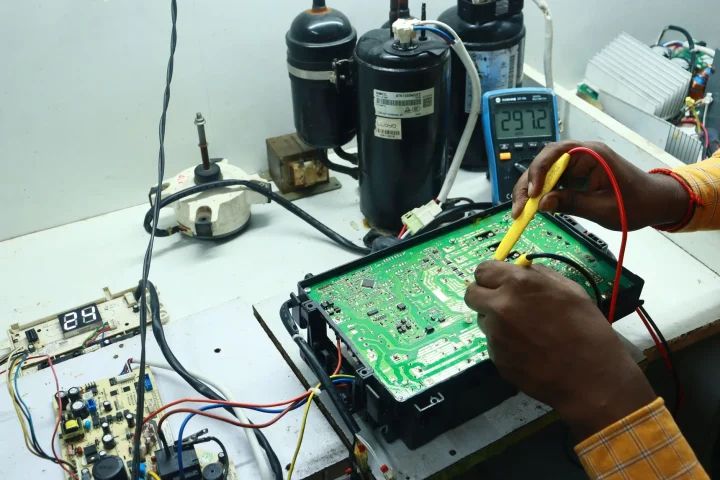
You do not need fancy gear, just a basic multimeter, the kind you can buy for 20 to 40 dollars. Set it to DC volts and follow this order.
- Turn the circuit on and let the device draw its normal load. Voltage drop only shows up under load, so this step is not optional.
- Put the red probe on the battery positive terminal and the black probe on the device’s positive terminal. Read the number. That is your drop on the positive leg.
- Do the same on the negative side: battery negative to device negative.
- Add the two readings. If the total is more than 3 percent of your system voltage (about 0.36 volts on 12V) for a critical circuit, your wiring is too small.
Where voltage drop hides on most boats
Some circuits are far more likely to bite you than others, and knowing the usual suspects saves you hours of chasing.
High-draw runs top the list: windlasses, bow thrusters, and inverters can pull 50 to 150 amps, and even a short run needs surprisingly heavy cable. If you are adding an inverter, our boat inverter and charger guide gets into the cable sizing those loads demand.
Long runs to the bow are next: anchor lights, windlasses, and forward electronics sit at the far end of the boat, so distance stacks up fast. And do not forget the ground path. A skimpy negative return or a shared busbar is just as capable of starving a device as the positive wire.
How fuses and breakers fit into all of this is worth understanding too, and our comparison of fuses vs circuit breakers on boats explains why protection sizing and wire sizing are two separate jobs.
Building the right mental model
Once it clicks, voltage drop stops being mysterious. Picture the whole circuit as a loop, measure the round trip, know the load in amps, and pick a gauge that keeps critical gear under 3 percent. That is the working model, and it will serve you on every project from a single cabin light to a full rewire.
If you are just getting your bearings on how a boat’s DC system fits together, start with our 12V boat wiring guide for beginners, then come back to voltage drop as you size each run. For a plain-language refresher on the underlying idea, the Wikipedia entry on voltage drop is a solid read.
Spend a little extra on copper, measure your runs honestly, and wire the important stuff to the tighter standard. Do that and your gear will run the way it did on the bench, every time you flip the switch.
Frequently asked questions
What is an acceptable voltage drop on a 12V boat circuit?
The marine standard is 3 percent for critical circuits like bilge pumps, nav lights, and electronics, which is about 0.36 volts on a 12V system. Non-critical circuits like cabin lights can tolerate up to 10 percent. When in doubt, wire everything to the tighter 3 percent target.
Do I measure wire length one way or round trip for voltage drop?
Always round trip. Current flows out on the positive wire and back on the negative, so both legs count. A device 15 feet from the battery sits on a 30-foot circuit, and sizing for only 15 feet leaves your wire half as heavy as it needs to be.
Will a bigger fuse fix voltage drop?
No. A fuse protects the wire from overheating and catching fire, not your device from starving. If the wire is too thin, a larger fuse just lets more current through undersized wire, so the circuit runs hot and weak while the fuse sits there happy. The real fix is thicker wire, meaning a lower gauge number.
How do I measure voltage drop with a multimeter?
Turn the circuit on under normal load, since drop only shows up when current flows. Set the meter to DC volts, read the drop from battery positive to device positive, then from battery negative to device negative, and add the two. If the total tops 3 percent of system voltage on a critical circuit, your wiring is too small.
Why does my electronic gear work on the bench but weaken once installed?
The bench test uses short, heavy leads right at the battery, so there is almost no voltage drop. Once the same device is fed through a long, thin run on the boat, the wire eats enough voltage to make it browning out under load. Upsizing that run usually cures the problem for the cost of a few dollars in copper.