AGM Battery Care Checklist for Boats


Most AGM batteries on boats do not die of old age. They get murdered, slowly, by a charger set to the wrong profile or a bank that sits at half charge all winter. AGM stands for Absorbed Glass Mat, a sealed lead-acid battery where the acid is held in a fiberglass mat instead of sloshing around as liquid. That sealed design is exactly why people love them on boats, and also why they punish neglect so quietly. You will not see bubbling or smell anything. The battery just quietly loses capacity until the day your windlass groans and stops halfway up.
Good news: keeping an AGM bank healthy is mostly a short list of habits, not a science degree. This checklist walks through each one, and tells you why it matters so you can adapt it to your own boat.
Get the charging right first
If you fix only one thing on this list, fix charging. An AGM lives or dies by the voltage you feed it. Push too much and you dry out the mat permanently, because a sealed battery cannot be refilled with distilled water the way a flooded one can.
Start at your charger or inverter-charger and confirm it is set to an AGM profile, not “flooded,” “wet,” or a generic default. The numbers differ by brand, but a typical AGM wants roughly 14.4 to 14.6 volts during absorption (the constant-voltage phase where the last 20 percent of charge goes in) and about 13.4 to 13.7 volts for float (the trickle that holds it topped up). Check your battery’s data sheet for the exact figures, then match the charger.
If your boat has an alternator charging the house bank, that matters too. A cheap internally regulated alternator can undercharge an AGM, leaving it chronically at 80 percent, which sulfates the plates. An external regulator set to an AGM profile fixes this, and it is worth the roughly 250 to 400 dollars if you run a serious house bank. For how the whole charging picture fits together, the Marine Battery Bank Setup Guide lays out the sources and how they should coordinate.

Watch your depth of discharge
State of charge is just how full the battery is, from 100 percent down to empty. Depth of discharge is how far you drew it down before recharging. AGMs hate deep, repeated discharges more than almost anything else you can do to them short of overcharging.
The practical rule: treat 50 percent as your floor for daily use. A 100 amp-hour AGM gives you about 50 usable amp-hours before you should be plugging back in. Dip to 50 percent occasionally and you are fine. Do it every single night for a week of anchoring and you will feel the bank sag.
Here is roughly how discharge depth trades against battery life for a typical quality AGM:
| Average depth of discharge | Approximate cycle life | What it means in practice |
|---|---|---|
| 50 percent | 400 to 600 cycles | Comfortable target for house banks |
| 30 percent | 800 to 1200 cycles | Gentle use, long life, but oversized bank |
| 80 percent | 150 to 300 cycles | Hard on the battery, plan to replace sooner |
The fix for chronic deep discharge is usually a bigger bank, not gentler habits. If your numbers feel tight, run them properly with How to Size a House Battery Bank before you buy anything.
Keep a battery monitor honest
You cannot manage what you cannot see. A resting AGM at 100 percent sits around 12.8 to 12.9 volts, at 50 percent around 12.1 to 12.2 volts, and a scary 11.8 or below means you drove it deep into the danger zone.
Voltage alone is a rough gauge, though, because it swings under load. A shunt-based battery monitor that counts amps in and out gives you a real state of charge percentage. Expect to spend 150 to 300 dollars on a decent one, and consider it the cheapest insurance on the boat.
Inspect the physical connections
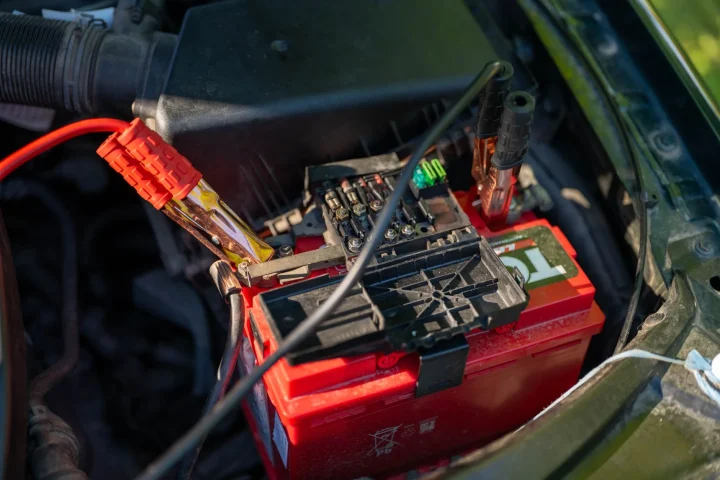
A boat I rewired last spring had a “dead” AGM bank the owner was ready to throw away. The batteries were fine. The problem was a corroded negative terminal that had gone green and fuzzy under a loose wing nut, choking off half the current. Ten minutes with a wire brush and a proper torque brought it back.
So walk the bank with your hands, not just your eyes. Every connection should be clean, dry, and tight to spec, usually around 10 to 12 newton-meters for common marine terminals, though you should check the maker’s figure.
- Look for white or green powder (corrosion) on terminals and lugs.
- Wiggle each cable. Nothing should move at the terminal.
- Confirm your interconnect cables are heavy enough, typically 2/0 gauge for a 400 amp-hour bank feeding an inverter, not undersized wire that overheats.
- Coat clean terminals with a thin film of dielectric grease or a corrosion inhibitor to slow the salt.
If your bank is wired to boost voltage or capacity, the way you join batteries changes what you inspect. Wiring Batteries in Series and Parallel covers why a weak link in one string drags the whole set down.
Balance the bank and match your batteries
Batteries wired together should age together. In a healthy parallel bank, every battery should read within about 0.2 volts of its neighbors at rest. A cell that sits noticeably lower is the one dragging the others down and it will only get worse.
Never mix an old AGM with a fresh one in the same bank, and never mix chemistries. An AGM and a flooded battery want different charge voltages, so one always gets abused. If you are still deciding what to buy, AGM vs Flooded vs Gel Batteries compares the tradeoffs honestly.
Winterize and store without killing it
Storage is where good batteries quietly go bad. A lead-acid battery left at partial charge sulfates, and sulfation is the hard crystal buildup that permanently steals capacity. The colder it is, the slower self-discharge runs, which helps, but it does not stop.
Before you walk away for the season, charge the bank to 100 percent. Then either leave a quality maintainer connected, or plan to top it back up every 30 to 45 days. If you fully disconnect and forget it for five months, expect to come back to a tired bank at best and a dead one at worst.
Solar makes winter storage almost effortless because even a small panel keeps the bank floated all season. The Marine Solar Power Setup Guide shows how to size a panel and controller for exactly this kind of maintenance duty. For the broader safety picture on marine electrical work, the BoatUS expert advice library is a solid, plain-language reference, and the American Boat and Yacht Council publishes the standards most surveyors actually hold boats to.
Your season-long rhythm
None of this takes long once it becomes routine. A five-minute look at the monitor each morning at anchor, a terminal check every couple of months, and a real plan for storage will get most quality AGMs to seven or eight years instead of three.
The batteries are rarely the weak point. The habits around them are. Set the charger correctly, respect that 50 percent floor, keep the connections clean, and give the bank a full charge before you leave it, and your AGMs will pay you back with years of quiet, reliable power.
Frequently asked questions
What charging voltage does an AGM battery need on a boat?
Most marine AGM batteries want roughly 14.4 to 14.6 volts during absorption and about 13.4 to 13.7 volts for float. Always confirm the exact figures on your battery's data sheet, then set your charger to a dedicated AGM profile. Using a flooded setting often pushes voltage too high and dries out the battery over a season.
How low can I discharge an AGM battery before it gets damaged?
Treat 50 percent state of charge as your daily floor, so a 100 amp-hour AGM gives about 50 usable amp-hours. Occasional deeper draws are survivable, but repeated deep discharges shorten life sharply. Recharge fully within a day or two to avoid sulfation.
How long should an AGM battery last on a boat?
A quality AGM that is charged correctly and kept off the 50 percent floor commonly lasts seven to eight years. Abused ones, usually from the wrong charger profile or chronic deep discharge, can fail in three. Good storage habits over winter make a large difference.
How do I store an AGM battery over winter?
Charge the bank to 100 percent first, then either leave a quality maintainer connected or top it back up every 30 to 45 days. A small solar panel can float the bank all season with no effort. Leaving it disconnected and forgotten for months invites sulfation and lost capacity.
Can I mix an old AGM with a new one in the same bank?
No. Batteries in a bank should be the same age, size, and chemistry so they charge and age together. An old battery drags the newer ones down, and mixing an AGM with a flooded battery means one always gets the wrong charge voltage.